
Global smartphone market grew 2% in 2025, while memory headwinds set the stage for a challenging 2026 – Omdia – March 04, 2026.
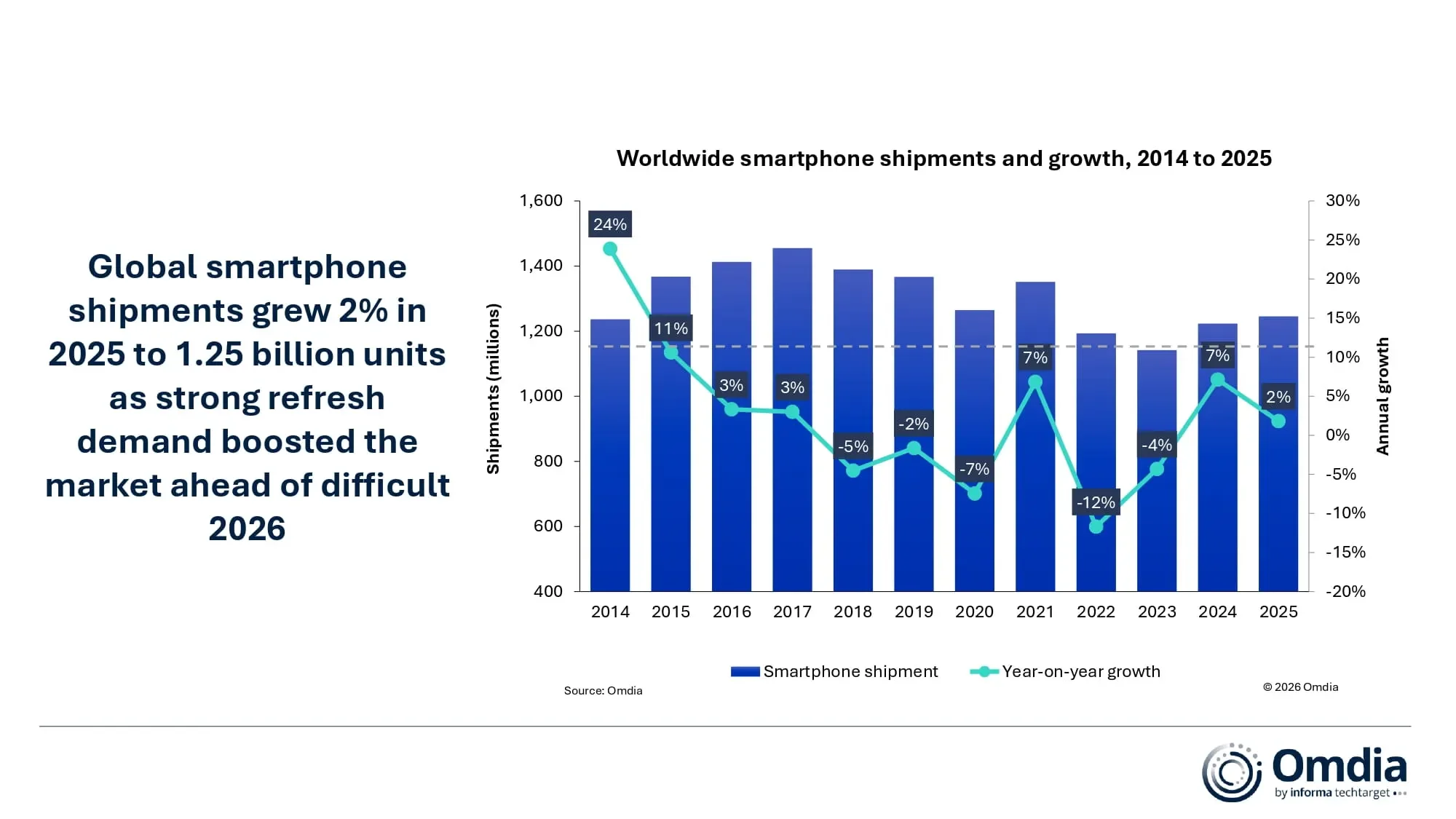
The latest research from Omdia reveals that global smartphone shipments grew by 2% in 2025 to 1.25 billion units, marking the highest annual level since 2021. All regions grew compared to 2024, except for Greater China, which marginally declined amid the fading effect of the national subsidy scheme that boosted its performance in early 2025. Strong demand from both upgraders and replacement-buyers continued to boost the market, as several vendors broke records despite uncertainty reigning in the business environment throughout the year.
The smartphone market ended 4Q25 with 4% year-over-year growth, bolstered by seasonal tailwinds and strong vendor performance. Despite this momentum, rising costs for key components and memory late in the period have started to dampen volume growth expectations for the start of 2026.

Runar Bjorhovde
Apple delivered its highest annual volume ever in 2025 as iPhone shipments grew 7% to 240.6 million units, helping it maintain the title as the world’s largest vendor for the third consecutive year. An all-time high quarterly iPhone volume in 4Q25 fueled its performance, with Apple notably posting 26% year-on-year growth in Mainland China driven by stronger iPhone 17 series demand. Samsung delivered a meaningful rebound in 2025 after three consecutive years of annual declines, growing 7% year on year and finishing marginally behind Apple. The year culminated in a standout fourth quarter, with shipments up 16% YoY, supported by resilient flagship demand alongside a notable recovery in mass-market volumes. Samsung maintained healthy Galaxy S and Z shipments while regaining share in entry-level and mainstream tiers (A0x and A1x), marking an important reversal after several years of pressure at the lower end of the market.
Xiaomi defended its third-place position in 2025, despite a tougher finish to the year, with shipments declining 2% amid entry-level softness and a sharp 4Q25 contraction in key markets. Expanding value growth through a broader portfolio push from POCO to premium and AIoT across retail remains key. Meanwhile, vivo claimed the fourth spot for the first time, driven by continued success in India alongside a consistent performance in its domestic market, to grow 4% to 105.3 million units. OPPO completed the top 5, with its shipments returning to growth in 4Q25 after a tricky first half of 2025 with newly launched A6x models. OPPO reached 100.7 million units in 2025, down 3% from 2024. With realme going under OPPO’s umbrella from 2026, OPPO will gain key volume and market strengths that can help it challenge for a higher position in the rankings.
Beyond the top 5, several vendors continue to experience positive demand despite challenging market conditions. HONOR’s and Lenovo’s grew 11% and 6% respectively, reaching record highs, with growth from rapid geographical expansion amid fierce competition in their core markets. Huawei continued growing as it reclaimed the top spot in Mainland China for the first time in five years. Nothing was the fastest-growing vendors of 2025, with shipments growing 86% to surpass 3 million units.

“Although 2025 overall has been a positive year for most vendors, headwinds are building for the 2026 outlook,” said Runar Bjorhovde, Senior Analyst at Omdia. “According to the recent Omdia report, 'DRAM Eats Smartphones: What Matters for Success in 2026,' escalating supply-side pressures in DRAM, NAND, and other semiconductors are a primary concern for vendors. These constraints threaten to squeeze margins, force pricing adjustments, and ultimately dampen consumer demand. However, vendors are not impacted similarly. Particularly those operating with smaller scale, limited long-term relationships with suppliers, high LPDDR4/4X exposure, and large low-end shares will be particularly exposed. It is also essential that vendors manage pressure points in the supply chain and sales channel effectively with long-term relationships in mind, while attempting to limit the end-buyers’ exposure to the increased costs.”
To learn more, visit: www.omdia.tech.informa.com