

Curated Insights. Strategic Impact. Targeted Engagement.
Since 2006, BizTechReports has delivered independent reporting on how emerging technologies reshape industries, organizations and decisions. Our editorial lens focuses insights — from analysts, tech developers, and enterprise leaders — for syndication through trusted media partners to reach key decision-makers in finance, healthcare, manufacturing and more.
Latest News

The 2026 ISG Provider Lens Medical Device Digital Services report for the U.S. finds that digital investment is increasingly focused on complete product lifecycles rather than isolated technology programs. As devices become more connected, engineering, regulatory affairs, quality management, cybersecurity and post-market operations are becoming interdependent functions that require an integrated digital foundation. A software update can simultaneously affect validation evidence, cybersecurity posture, regulatory documentation and field performance, ISG says.

According to the IDC Worldwide AI and Generative AI Spending Guide 2026 V2, European spending on artificial intelligence will reach nearly $470 billion in 2030, growing at a compound annual growth rate (CAGR) of 35.0% over the 2025–2030 forecast period. Generative AI (GenAI) solutions are already embedded across enterprise deployments and are expected to account for more than 55% of the total market by the end of the period.

The Gartner Quarterly Emerging Risk Report series compiles insights and perspectives from enterprise risk management (ERM) leaders, risk professionals, auditors and senior executives on emerging and future risks. Gartner surveyed 316 senior executives and risk managers across a range of sectors and regions.

The 2026 ISG Provider Lens Private/Hybrid Cloud — Data Center Services report for France finds that the country is expanding domestic computing infrastructure while strengthening its focus on digital sovereignty and AI. France’s national AI strategy places increasing priority on computing infrastructure, with more than €109 billion in investments being announced at the AI Action Summit in Paris in 2025. These developments are making local control and infrastructure availability more consequential in enterprise cloud planning.

According to IDC’s Worldwide AI and Generative AI Spending Guide, V2 2026, August, Asia/Pacific AI and GenAI investment, including China and Japan, is set to grow from $121.5 billion in 2025 to $555.2 billion by 2030, a compound annual growth rate (CAGR) of 35.5%. This growth reflects enterprises moving generative AI and Agents beyond isolated pilots and into core, enterprise-wide operations. Agentic AI and orchestration platforms emerge as key catalysts, enabling enterprises to unify predictive, generative, and prescriptive capabilities within a single governance framework rather than managing them as separate initiatives.

Customer service organizations are prioritizing technology investments as AI rapidly reshapes the function. A Gartner survey of 199 service and support leaders conducted in April through May 2026 revealed that spending on AI has increased by 38%, while overall service and support function budgets have grown just 2%.

The 2026 ISG Buyers Guides for Learning and Development report that traditional learning management systems have merged with learning experience platforms to form a new category that combines administration, skills awareness and engaging user experiences. Integrated with human capital management systems, human resources data, collaboration applications and content providers, these platforms allow organizations to carry out successful skills strategies without additional administrative burdens.

The worldwide external OEM enterprise storage systems (ESS) market continued its sharp acceleration in the second quarter of 2026, reaching $10.3 billion in vendor revenue, a 33.6% year-over-year increase, according to IDC’s Worldwide Quarterly Enterprise Storage Systems Tracker. It represents the second-highest quarterly total in the tracker’s history, trailing only Q4 2025, and the highest revenue ever recorded outside a fourth-quarter period. ESS growth accelerated further from the 28.7% rate posted in the first quarter of 2026, marking a second consecutive quarter of acceleration after the market’s 3.9% full-year 2025 growth rate.
Editor's Pick

As enterprises move beyond isolated digital initiatives and begin operationalizing AI across functions, many are encountering unexpected friction—ranging from unclear project ownership to gaps in governance, security, and execution. These challenges are prompting a broader reassessment of how external partners are selected and measured.

The growing reach of AI across business operations is reshaping the demands placed on data centers in every industry. This BizTechReports briefing synthesizes insights from four recent reports to explore how data centers are evolving—consolidating platforms, securing new power sources, adopting more flexible investment models, and redesigning infrastructure to support AI at scale.

In a time when enterprise IT leaders are facing a perfect storm of endpoint complexity, cloud sprawl, and heightened security risks, a new vision for the digital workspace is emerging. Omnissa, the end-user computing spinout from VMware following its acquisition by Broadcom, is aiming to redefine how organizations manage performance, productivity, and policy enforcement.

The International Data Corporation (IDC) released its latest forecast for Worldwide Edge Computing Spending Guide, featuring a new enterprise industry taxonomy. The newly added structure now includes 27 industries, providing a more detailed and nuanced segmentation by region and country across key manufacturing sectors such as automotive, industrial, consumer packaged goods, life sciences, high-tech and electronics, and aerospace. According to IDC, global spending on edge computing solutions accounts for nearly $261 Billion in 2025 and is projected to grow at a compound annual growth rate (CAGR) of 13.8%, reaching $380 Billion by 2028.
Special Reports

The accelerating growth of AI-generated content, higher-resolution media, immersive applications and enterprise video communications is forcing organizations to reconsider how they manage one of the largest contributors to global network traffic. Rather than treating video compression as a narrow technical function, enterprise technology leaders are increasingly evaluating it as a strategic lever for controlling infrastructure costs, improving energy efficiency and supporting long-term digital growth.

An Executive Q&A Session with Yuri Gubin, Chief Technology Officer at DataArt
The number of people who can build applications, automate processes and redesign work has dramatically expanded with the introduction of generative artificial intelligence and rise of agentic systems, creating a new challenge for enterprises trying to capture the benefits of distributed innovation without sacrificing governance, security or operational discipline.
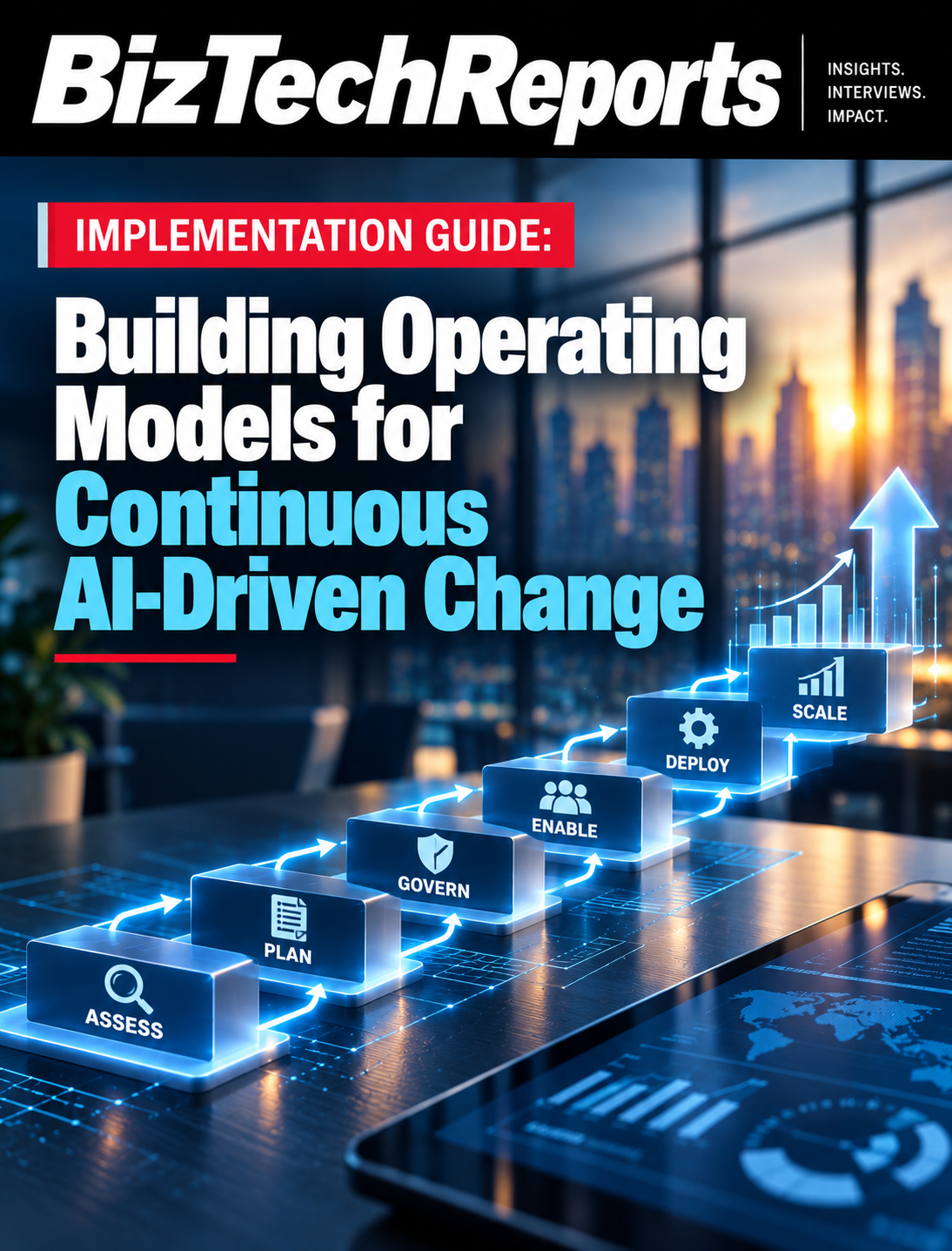
Enterprise leaders moving artificial intelligence from experimentation into everyday operations need management structures that can keep innovation aligned with business priorities as capabilities, workforce skills and operating requirements change. Establishing governance, defining new responsibilities for IT, improving visibility across business functions and creating mechanisms for employees to share successful innovations can help organizations turn rapidly evolving AI capabilities into repeatable business outcomes.

Artificial intelligence is introducing new capabilities into deception detection at a time when organizations are under increasing pressure to verify identity, intent, and credibility across both physical and digital environments. Law enforcement, intelligence, and investigative organizations are evaluating tools that analyze physiological and behavioral signals, including ocular response patterns.