
Multi-Orbit Satellite Architectures Force the Industry Toward Shared Operational Governance — August 26, 2026
A conversation with Helen Weedon, Managing Director of SIG
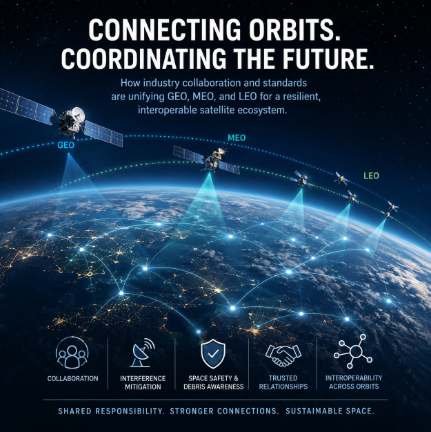
As satellite operators integrate geostationary orbit (GEO), medium Earth orbit (MEO), and low Earth orbit (LEO) systems into unified connectivity environments, the economics and governance requirements of the sector are being reshaped at nearly every level. Operators, regulators, manufacturers, and antenna providers are being forced to coordinate far more closely as multi-orbit architecture increase pressure for improved spectrum management, interoperability, standardized testing methodologies, debris mitigation policies, and cross-border operational governance.
The Satcoms Innovation Group, or SIG, has positioned itself at the center of those coordination efforts. Originally focused on satellite interference mitigation, the organization has expanded into multi-orbit coordination, standards development, artificial intelligence, interoperability, workforce development, and infrastructure governance.
In a recent BizTechReports executive interview, Helen Weedon, Managing Director of SIG, described an industry moving away from isolated operational models toward highly interconnected infrastructure environments that require continuous coordination between operators, manufacturers, regulators, testing organizations, and service providers.
"While we're still on a long path to fully achieve," Weedon said regarding full synchronization across orbital layers. "That coordination is really super important and we are making progress."
Multi-Orbit Operations Expand Industry Interdependence
Enterprise customers now expect connectivity services capable of dynamically shifting traffic between GEO, MEO, and LEO systems to address latency, resiliency, and bandwidth demands. Flat panel antennas, cloud-based orchestration platforms, software-defined networking, and growing spectrum congestion are forcing operators to coordinate across orbital layers that historically functioned independently.
Operators that once managed relatively isolated networks now face infrastructure environments where actions taken in one orbital layer can affect performance, service continuity, and operational risk elsewhere. The shift carries strategic implications for nearly every stakeholder category within the industry.
Equipment manufacturers and antenna providers are under pressure to ensure products function reliably across diverse orbital environments. Enterprise customers, aviation providers, maritime operators, and government agencies are placing growing emphasis on seamless connectivity that can dynamically leverage multiple orbital layers simultaneously. Satellite operators increasingly depend on cooperation with other operators to maintain network resiliency and manage operational incidents quickly.
Weedon described how SIG functions as an operational coordination framework for an industry confronting growing congestion, shared infrastructure dependencies, and expanding multi-orbit complexity. The organization helps establish communication channels and professional relationships between operators, manufacturers, testing organizations, and infrastructure providers before operational incidents occur — a foundation that becomes critical when organizations need to respond quickly to interference events, infrastructure disruptions, or potential collision risk coordination with the Space Data Association (SDA).
Weedon referenced a recent interference issue resolved within minutes because technical teams already had established contacts and coordination procedures in place.
"SIG laid the foundation for bringing those people together in a room so they know exactly who they're phoning when something happens," Weedon said.
SIG's Mission Expands Beyond Interference Mitigation
Weedon said SIG's mission now extends well beyond its origins in interference management into broader operational and implementation issues affecting the satellite ecosystem.
One major area involves the growing adoption of electronically steered flat panel antennas across aviation, maritime, enterprise, and mobility environments. Operators, manufacturers, and testing organizations are working to establish common testing methodologies and standardized performance metrics capable of supporting multi-orbit deployments. Without broader coordination, operators risk deploying systems based on inconsistent testing procedures or incomplete operational visibility.
"It needs to make sense for every single operator," Weedon said. "It needs to make sense for the manufacturers. It needs to make sense for the testing entities."
SIG is addressing the role of artificial intelligence (AI) and machine learning inside satellite operations. Weedon described growing interest in AI-driven tools capable of supporting interference prediction, anomaly detection, and operational management.
"There's a lot of tools that are being developed or research being done in terms of predicting when interference might happen," she said.
Satellite operators have long used automation in areas such as predictive monitoring and self-healing network operations. AI could further accelerate operational efficiency by automating portions of spectrum analysis, traffic optimization, fault detection, and network orchestration. The maturity of fully autonomous agentic AI systems within satellite environments remains an open question.
"So far I've seen lots of talk about how agentic AI is going to help," Weedon said. "I haven't seen any actual real examples of it working yet."
That caution reflects the reliability and resiliency requirements associated with critical communications infrastructure, where operational failures carry immediate commercial and service consequences.
Financial Pressures and Workforce Challenges Intensify
The growing operational complexity surrounding multi-orbit architecture is reshaping financial management priorities throughout the satellite sector. Satellite infrastructure requires sustained capital investment across long deployment cycles, and operators carry growing exposure to congestion, interference, cybersecurity threats, and orbital debris risks. Weedon said operators are increasingly focused on protecting long-term infrastructure value, noting that coordination failures affect more than internal operations.
"The absence of effective coordination can result in damaged reputations because customers [end users] are often the ones impacted," she said.
The industry is simultaneously confronting workforce pressures that could shape long-term operational competitiveness. Satellite companies now compete aggressively for engineering, cloud, AI, cybersecurity, and software talent against hyperscale cloud providers, defense contractors, and large technology firms. Weedon identified the talent gap as one of SIG's growing priorities, noting the organization is exploring a global initiative to connect industry projects with universities possessing relevant technical expertise — both to address immediate operational needs and to build future workforce pipelines for increasingly software-driven satellite environments.
Shared Coordination as a Competitive Differentiator
The satellite industry is entering a period in which operational coordination is becoming inseparable from infrastructure strategy itself. Multi-orbit architecture, AI-driven operations, cloud integration, debris mitigation, and interoperability requirements are converging into a governance challenge that no single operator can navigate in isolation.
Organizations such as SIG are functioning less as narrowly focused technical associations and more as operational coordination platforms that help the industry manage shared infrastructure risk and long-term resiliency. For satellite operators, the effectiveness of those coordination frameworks may prove as consequential to competitive positioning as the capabilities of the satellites themselves.
###