
India’s Tablet Market Rises 3.4% YoY in Q2 2026 to 1.1 Million Units – IDC – September 23, 2026
India’s tablet market (inclusive of detachable and slate tablets) shipped 1.1 million units in Q2 2026, up 3.4% year-over-year (YoY), according to the latest data from the International Data Corporation (IDC) Worldwide Quarterly Personal Computing Device Tracker. The detachable tablet category grew 16.5% YoY, while the slate tablet category declined 3.7% YoY.
The consumer segment remained flat YoY in Q2 2026, as demand plateaued amid rising device costs, though sales were sustained by promotions on e-tailer platforms. The commercial segment grew 10.1% YoY, supported by new manifesto deals concluded during the quarter and strong demand from the enterprise segment, where very large businesses (VLBs) and large businesses (LBs) posted YoY growth of 52.2% and 37.4%, respectively. SMBs also showed signs of recovery, as businesses placed orders following fiscal budget allocations.

Bharath Shenoy
Why It Matters
Consumer demand is plateauing. Rising device costs are capping consumer demand, though e-tailer promotions are helping sustain sell-through in the segment.
Commercial demand is broadening. Growth is no longer limited to large enterprise deals. Manifesto-driven purchases, SMB recovery, and steady VLB and LB demand point to a commercial segment drawing strength from multiple sources at once.
Market Dynamics: What Drove the Outcome?
A gradual shift in buyer preference: Growth was concentrated in form factors offering greater flexibility for productivity use cases, with adoption patterns pointing to sustained demand for devices that can double as laptop replacements
Manifesto deals and enterprise demand: New manifesto deals concluded during the quarter, combined with strong demand from very large and large businesses, propelled the commercial segment to 10.1% YoY growth.
SMB recovery following budget allocation: SMBs placed a healthy volume of orders after fiscal budget allocations came through, marking a recovery in a segment that had been comparatively subdued in recent quarters.
Segment Snapshot: Category Performance
Detachable Tablets: +16.5% YoY | Outpacing the overall market
Slate Tablets: -3.7% YoY | Continued to lose ground to detachable
VLB (Enterprise): +52.2% YoY | Strongest-performing enterprise sub-segment
LB (Enterprise): +37.4% YoY | Sustained double-digit growth
India Tablet Market at a Glance: Q2 2026
Total shipments: 1.1 million units (+3.4% YoY)
Consumer segment: flat YoY
Commercial segment: +10.1% YoY
Top five vendors: Samsung (#1), Lenovo (#2), Xiaomi (#3), Apple (#4), Acer Group (#5)
“The Indian tablet market is undergoing a gradual transition from entry-level consumption devices to more versatile, productivity-centric form factors,” said Priyansh Tiwari, research analyst, IDC India & South Asia. “While rising component and manufacturing costs continue to exert upward pressure on average selling prices (ASPs) in Q2 2026, vendors are strategically pivoting away from a sheer volume push toward value-driven growth. Rather than chasing low-margin, high-volume entry devices, brands are doubling down on high-value detachable, premiumization, and AI-led productivity features. Supported by expanding offline retail channels and strong demand from SMBs, this focus on value over volume is expected to stabilize margins and drive sustainable, long-term adoption across both the consumer and commercial segments.”
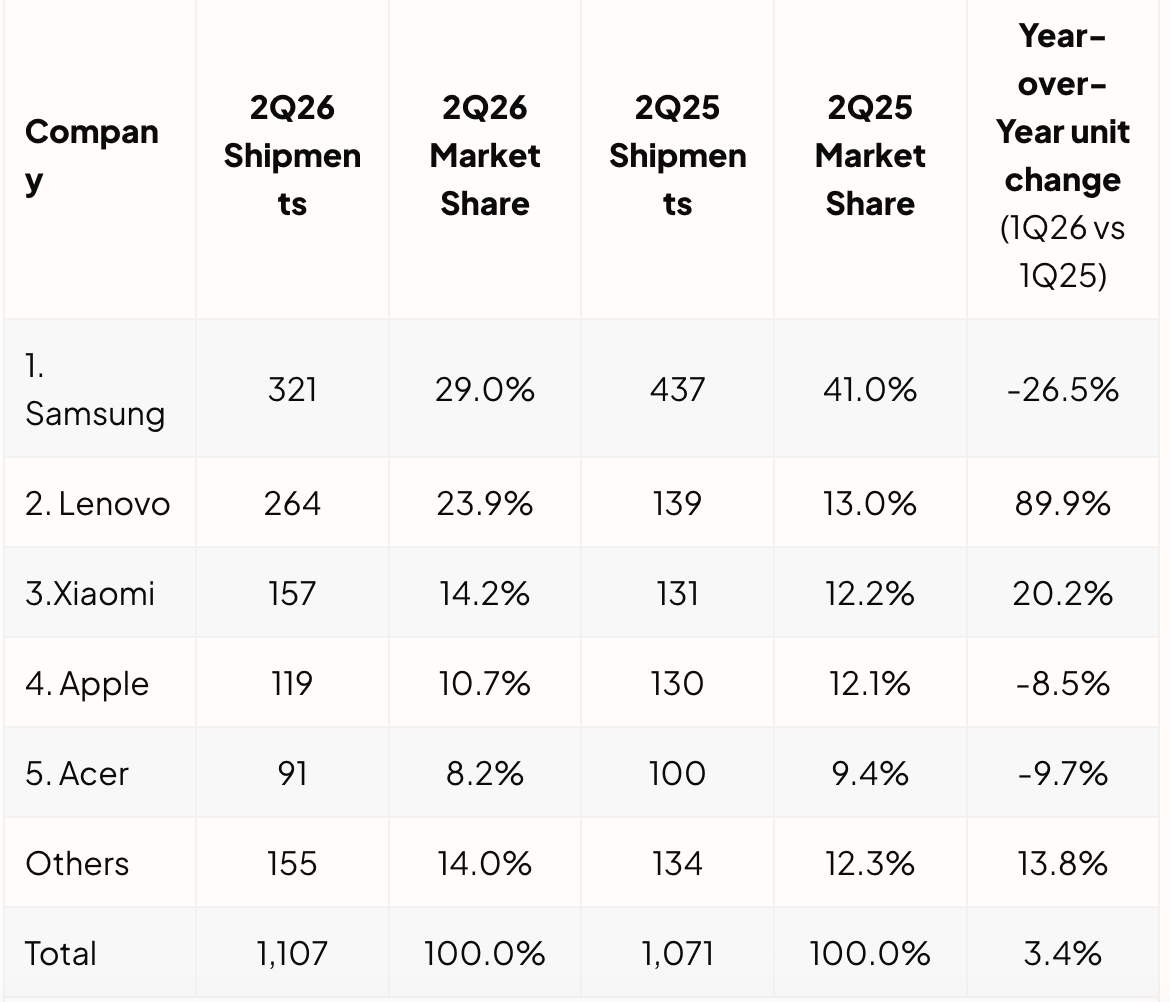
Vendor Landscape: Who Won the Quarter?
Samsung led the market with a 29% share in Q2 2026, topping the charts in both the commercial and consumer segments with shares of 31.4% and 27.6%, respectively. Samsung maintained its commanding leadership through a mix of high-volume mid-range sales and a premium “Galaxy AI” push. In the commercial segment, completed manifesto deals boosted volumes. Deals on the S10 Lite and A11+ during Prime Day sales also helped it capture the consumer market in the mid-premium segment.
Lenovo ranked second with a 23.9% share in Q2 2026, holding a 24.7% share in the commercial segment and 23.4% in the consumer segment. The company maintained its strong position in the commercial market by securing high-value enterprise deals and SMB volume orders during the quarter. It also benefited from better allocation and deals during Prime Day sales, as it leveraged its Motorola-branded tablets to target younger audiences.
Xiaomi ranked third with a 14.2% share in Q2 2026, supported by a strong 22.1% share in the consumer market. The brand achieved higher sell-in to offset the impact of price increases, aided by healthy demand for the Xiaomi Pad 8 and Redmi Pad 2. Despite rising prices, Xiaomi maintained a strong hold over the mid-range tablet segment by offering value-for-money devices at lower prices than competitors.
Apple ranked fourth with a 10.7% share in Q2 2026, holding a 6.3% share in the commercial segment and 13.2% in the consumer segment. Apple’s sales were driven by discounts offered during the Amazon Prime Day sale and improved product availability. The company also benefited from price increases implemented by other vendors earlier in the quarter, having held off its own increase until late in Q2.
Acer Group held fifth position with an 8.2% share, driven by a strong 22.5% share in the commercial segment through the fulfilment of high-volume education manifesto deals and public sector projects. The company also sustained momentum by catering to enterprise procurement and SMBs with its robust, productivity-focused portfolio.
IDC Outlook: What’s Next?
Looking ahead, IDC expects the shift toward value-driven growth to continue shaping India’s tablet market. Vendors are likely to keep prioritizing premiumization, AI-led productivity features, and detachable form factors over sheer volume, a strategy expected to support healthier margins even as ASPs remain under pressure. Continued momentum in offline retail expansion and sustained SMB demand should provide additional support to the market through the remainder of 2026.
“The commercial tablet market is set to remain robust in the coming quarters, underpinned by a strong pipeline of upcoming manifesto deals and steady procurement from enterprises and SMBs refreshing their device fleets,” said Bharath Shenoy, research manager, Devices Research, IDC India & South Asia. “Vendors are also using this window to push higher-specification devices, including AI-enabled processors, larger displays, and detachable form factors, as buyers increasingly evaluate tablets on productivity credentials rather than price alone. At the same time, with PCs becoming costlier, tablets are positioning themselves as a credible second option for budget-conscious buyers who need a capable computing device without the higher price tag of a notebook.”
To learn more, visit: www.idc.com