
The AI Jobs Boom Versus the Skills Bust – PwC and WEF –January 6, 2025
AI is poised to deliver a massive employment surge, with the global economy projected to create 170 million new roles by 2030, a net gain of 78 million jobs, according to the World Economic Forum (WEF). However, this historic jobs boom faces a critical systemic failure: the Skills Gap. Public data confirms the crisis is immediate: 63% of employers report skills shortages are blocking growth, and workers with proven AI skills already command a 56% wage premium, more than double last year’s figure. The real story isn't job creation, but the race to upskill nearly 60% of the global workforce to fill these new roles before automation makes the old ones obsolete.
A Jobs Boom With a Skills Time-bomb
The World Economic Forum’s Future of Jobs Report 2025 makes clear that the issue isn’t the number of roles, but how few people are ready for the ones AI is helping to create. What’s driving the job shift?
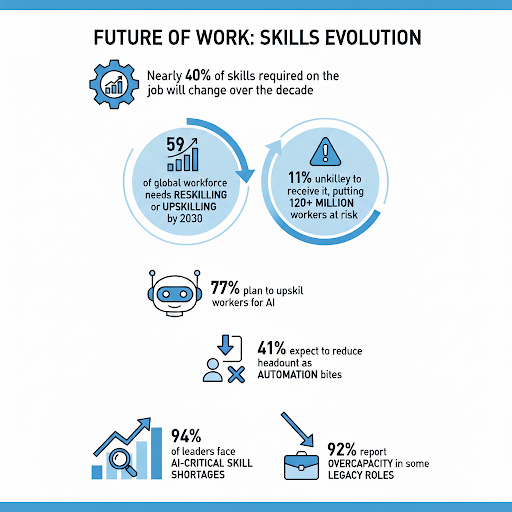
The chart provided by PwC and WEF illustrates how artificial intelligence is reshaping workforce skills and employment patterns. It shows that nearly 40% of the skills required for today’s jobs are expected to change over the next decade. According to the data, 59% of the global workforce will need reskilling or upskilling by 2030, while 11% of workers are unlikely to receive that training, placing more than 120 million people at risk. The graphic also indicates that 77% of organizations plan to upskill employees for AI, even as 41% expect to reduce headcount as automation expands. At the same time, 94% of business leaders report shortages in AI-critical skills, while 92% say they have excess capacity in some legacy roles.
Across these trends, WEF’s analysis consistently points to technological change, especially AI and automation, as the main engine of both new role creation and disruption to existing ones. Together, that’s a world simultaneously creating more AI-shaped jobs and shedding the jobs those workers currently do, without a clear, scaled bridge between the two.
Hiring data shows that this isn’t a theoretical problem. PwC’s 2025 Global AI Jobs Barometer tracks how the gap is already reshaping the wider labor market:
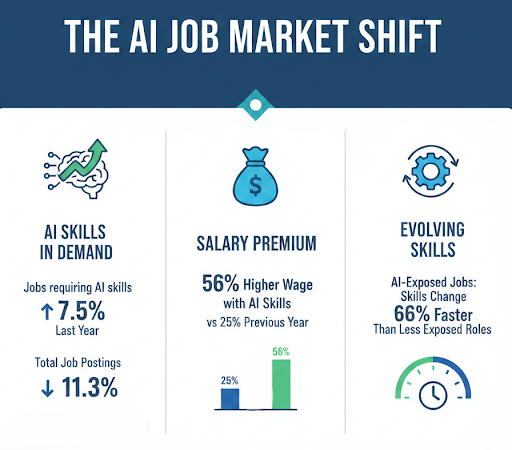
As the graphic shows, key shifts underway in the job market as artificial intelligence reshapes hiring, pay, and skill requirements. It shows that demand for AI-related skills continues to rise even as overall hiring slows. Jobs requiring AI skills increased 7.5% over the past year, according to the chart, while total job postings declined 11.3% during the same period, highlighting a divergence between general employment trends and AI-specific roles.
The chart also points to a growing wage premium for workers with AI expertise. Employees with AI skills earned salaries 56% higher than the prior year, compared with a 25% increase reported the year before, indicating that employers are paying significantly more to attract scarce technical talent.
At the same time, the graphic shows that skill requirements themselves are changing more rapidly in AI-exposed roles. Jobs most affected by AI are experiencing skills evolution 66% faster than roles with lower exposure, underscoring the pace at which job definitions are shifting. Taken together, the figures illustrate a labor market in which AI capabilities are becoming both more valuable and more volatile, intensifying pressure on workers and employers to adapt.
Put simply, employers are paying for capability, not tenure. Taken together, this data explains why junior candidates who can prove AI fluency are increasingly leapfrogging senior candidates who cannot.
Upskilling Systems are Still Catching-up
If AI skills are the new hiring threshold, learning infrastructure is still in beta. Training teams, HR, and policymakers are all moving, but rarely at the same speed.
According to LinkedIn’s Workplace Learning Report 2025:
71% of Learning & Development (L&D) — the teams responsible for employee training, upskilling, and workforce capability building — say they are exploring, experimenting with, or integrating AI into their work. This is evidence that training teams are scrambling to keep pace.
91% of L&D leaders say “human skills” such as critical thinking, collaboration, and adaptability are becoming more important in an AI-driven workplace, not less.
Yet organizational planning is lagging behind ambition. BearingPoint’s global survey finds that fewer than half of organizations (46%) embed workforce planning into their AI transformation, despite those acute skill shortages.
Policy efforts are scaling, but the gap remains wide. The World Economic Forum’s Reskilling Revolution aims to equip 1 billion people with better education and skills by 2030, an effort that matches the scale of the challenge in theory. In practice, the Future of Jobs data suggests a significant gap between ambition and delivery.
The picture is of a world where AI adoption is moving at platform speed, and formal learning systems are still running on human time. So what do you do if you’re entering that world as a worker, or trying to steer it as a leader?
How Workers and Leaders Can Close the Gap
The data doesn’t guarantee a crisis, but it does make the stakes clear. The upside WEF forecasts, 78 million net jobs in an AI-transformed economy, will only materialize if workers, employers, and policymakers treat AI skills as a shared, urgent project. Experts at OutreachX suggest a few practical ways for both employees and employers to narrow this gap.
For Workers
Treat AI like a second language. Build hands-on competence with mainstream tools (chatbots, copilots, analytics platforms) and documents that are used in real projects. The wage premium is already going to people who can show these skills, not just list them.
Stack AI on top of domain expertise. The biggest gains are going to people who blend AI with finance, healthcare, law, engineering, operations, and other specialties, not to generic “prompt writers.” The most valuable roles are hybrids.
Invest in durable skills. Use AI courses to sharpen analytical thinking, communication, and problem-solving as much as technical prompts. Those human skills show up in every growth scenario and are exactly what L&D leaders say they value most in an AI-driven workplace.
For Employers
Make AI training a baseline, not a perk. If AI is a hiring filter, it should also be a core part of onboarding and continuous learning, not something employees must figure out alone. WEF and PwC data both show that the organizations reaping the rewards are those investing systematically in capability.
Measure skills, not just CVs. Update job descriptions, promotion criteria, and performance reviews to reward demonstrated AI capability and cross-functional learning, not just years served. That’s the only way to align internal incentives with the external labor market.
Align AI strategy and workforce planning. Treat reskilling, internal mobility, and job redesign as central workstreams in AI programs, not afterthoughts once tools are bought. Without a plan for people, even the best AI strategy is unfinished.
The Race for Readiness is Still Open
Taken together, the major datasets do not point to an inevitable “end of work.” Instead, they describe an open race between automation, skills, and institutions. Whether the forecast 78-million-job gain in an AI-transformed economy actually materializes will depend on how quickly education systems, employers, and policymakers can close the training gap relative to the pace at which new AI-era roles emerge. If they keep up, AI is likely to be remembered less for the jobs it displaced than for the new kinds of work it made possible; if they fall behind, the defining constraint will not be a lack of jobs, but a shortage of people prepared to do them.
To learn more, visit: www.pwc.com